
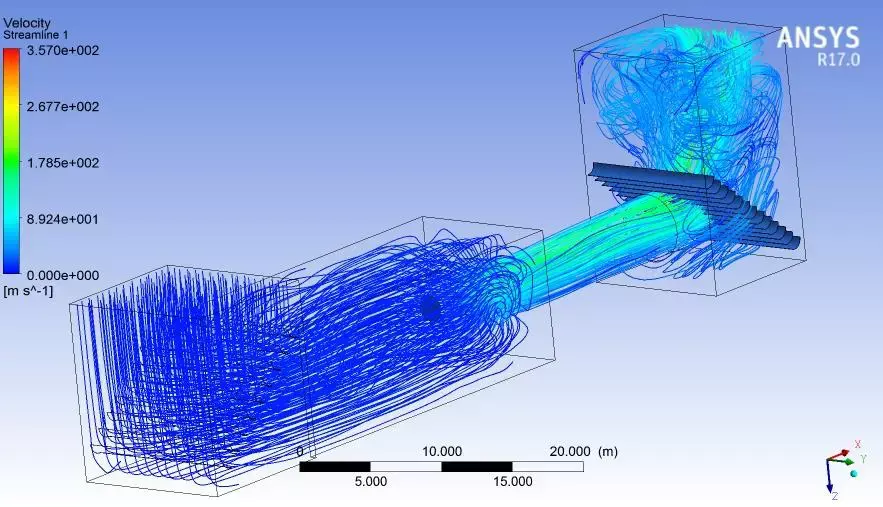
**Comprehensive Analysis Utilizing ANSYS Solutions**
**Fluid Flow Analysis (CFX)**
Harness the power of ANSYS CFX for advanced fluid flow simulations. This robust tool is specifically designed for complex fluid dynamics, enabling engineers to analyze the behavior of fluid flows across various applications. With its high-performance computing capabilities, CFX accurately resolves fluid movement, turbulence, and heat transfer, providing invaluable insights for optimizing designs and enhancing performance.
**Fluid Flow Analysis (FLUENT)**
ANSYS FLUENT is a premier computational fluid dynamics (CFD) tool, renowned for its versatility and detailed simulation capabilities. It allows for precise modeling of fluid flow in a range of scenarios, including internal and external flows, multiphase flows, and chemical reactions. By leveraging FLUENT, engineers can identify critical flow patterns, improve energy efficiency, and ensure optimal functionality in their designs.
**Fluid Flow Analysis (POLYFLOW)**
For applications involving non-Newtonian fluids or complex viscosity behaviors, ANSYS POLYFLOW stands out as the ideal choice. This specialized tool is tailored for simulating the flow of polymer melts, food products, and other complex fluids. Using POLYFLOW, engineers can gain a deeper understanding of how materials behave under various processing conditions, leading to improved product quality and performance.
**Harmonic Response Analysis**
Dive into the frequency-domain response of structures and components with ANSYS's Harmonic Response Analysis capabilities. This method is vital for evaluating how systems react to sinusoidal forces over a range of frequencies. Through harmonic response analysis, engineers can predict resonance conditions, assess dynamic stability, and optimize designs to mitigate potential failure risks.
**Hydrodynamic Diffraction Analysis**
Utilizing ANSYS for hydrodynamic diffraction analysis provides critical insights into wave interactions with submerged structures. This advanced analysis helps engineers design robust offshore installations, marine vehicles, and coastal structures by accounting for the complex interactions between waves and objects. Accurate predictions of wave forces and patterns ensure the resilience and reliability of marine designs.